Sign in. It’s quick, free and it’s up to you.
An account is an optional way to support the work we do. Find out more.
Sign in. It’s quick, free and it’s up to you.
An account is an optional way to support the work we do. Find out more.
LAST UPDATE | 24 Nov
THE TAOISEACH AND the Minister for Health both faced questions after the HSE board announced on Monday that HSE chief executive Anne O’Connor was removed as chief executive after less than nine months in the role.
There have been calls for the HSE board to resign over its handling of the situation, while Health Minister Jennifer Carroll MacNeill was criticised after she failed to shed any light on why O’Connor had been sacked before today.
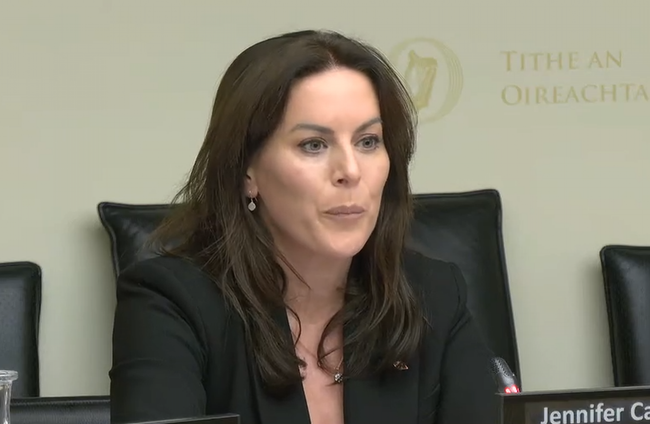
Carroll MacNeill appeared before the Oireachtas Budgetary Oversight Committee, answering questions about these matters and the HSE’s spending overrun. During the meeting, she told the committee she was informed of the board’s decision on Thursday.
Taoiseach Micheál Martin told the Dáil today that the HSE board agreed a set of performance objectives after O’Connor’s appointment and last week they “unanimously” concluded that her removal was necessary for the “effective and efficient performance” of the HSE.
The HSE’s board has released a statement, which echoed the Taoiseach’s comments in the Dáil.
O’Connor said she was “very deeply surprised and disappointed” by the manner in which she was informed.
Updates by Jane Moore and Sophie Finn.
Anne O’Connor’s name has been mentioned more times than we can count in the last 24 hours. But who is the former HSE executive who has been dismissed after just nine months?
Our news correspondent Eimer McAuley did a deep dive on O’Connor – a Galway native who was very much an HSE insider when she took over, having spent decades working her way through the organisation.
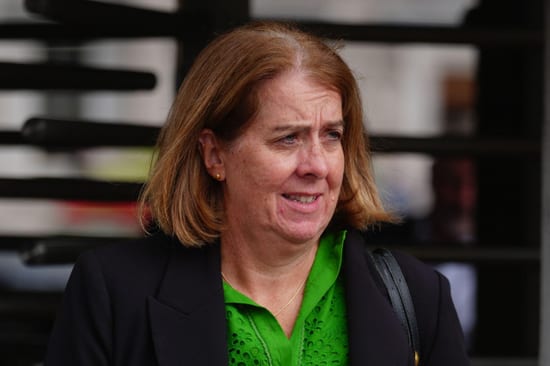 Anne O'Connor has been removed from her post as CEO of the HSE. Alamy Stock Photo
We may not know the reason for O’Connor’s removal yet – but we know that the decision was taken by the board of the health service, and that O’Connor plans to challenge the matter “as vigorously as possible”.
Pressure is mounting on the board of the HSE, with the Irish Nurses and Midwives Organisation (INMO) and the Irish Hospital Consultants Association (IHCA) both calling for the board to resign over its handling of the situation.
But who are the 11 members on the governing body that sacked O’Connor?
Unsurprisingly, the HSE board removing O’Connor from her position has been raised by several politicians speaking on the plinth of Leinster House this afternoon.
Sinn Féin health spokesperson David Cullinane says it is “incredible” no reasons have been provided for O’Connor’s sacking 24 hours after the news broke.
Meanwhile, Labour health spokesperson Marie Sherlock says it is “perverse” that the HSE board sacked the chief executive in the middle of a “very challenging time” for the health service.
“What did Anne O’Connor do to justify being sacked?” - Sinn Féin health spokesperson says it is incredible that 24 hours after the news broke that the HSE CEO has been fired, we still have no answers. @thejournal_ie https://t.co/tSt4uTrFGa
— TheJournal Politics (@TJ_Politics) November 24, 2026
Tony O’Brien, former Director General of the HSE, told The Journal that there is “no way” the board would have taken the decision to remove Anne O’Connor from her post “without political cover”.
“The whole way it’s been handled this week really does stink, and it’s clear that [the Health Minister] knew before Anne did.
“It’s also incredibly disrespectful that the board met on a Thursday and that the chair, who is UK-based, didn’t communicate the decision to Anne in person but instead arranged a virtual meeting,” he added.
O’Brien said that O’Connor, who served as the HSE’s director for mental health services when he was director general, is perhaps “the best qualified, best trained individual” of all the people who have ever been chief executive of the health service, himself included.
He added that she has been “constantly disempowered” through moves to give the Department of Health control of the day-to-day spend of four regions, and brought in new recruitment controls.
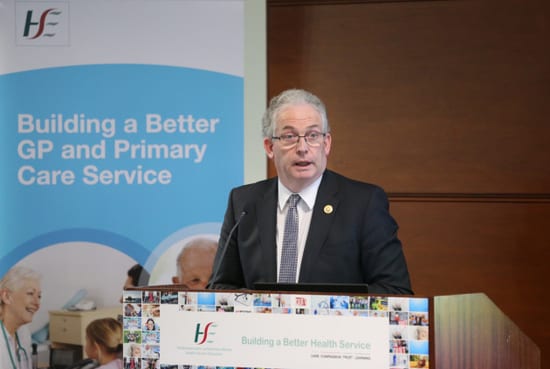 Tony O’Brien is the former HSE Director General. Sasko Lazarov / Photocall Ireland
Neither the Taoiseach, the Tánaiste nor any ministers spoke to the media this morning before today’s cabinet meeting.
Every week, it is typical for ministers and government leaders to stop to speak to reporters outside Government Buildings – and our political team was expecting this as usual this morning.
However, not today. In the midst of the HSE controversy, no one came out or stopped to answer questions from reporters.
Instead, a government spokesperson said the Taoiseach would speak to the matter in the Dáil this afternoon in Leaders’ Questions, which falls under Dáil privilege.
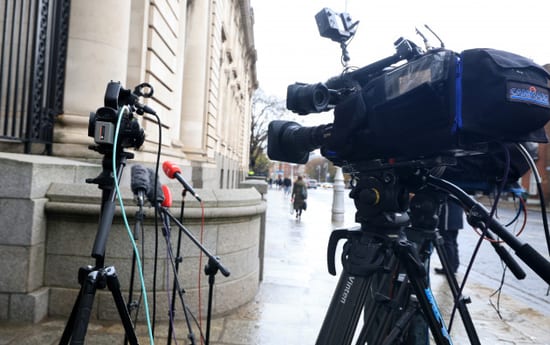 Photo shows the media waiting for ministers to arrive at today's cabinet meeting at government buildings. Leah Farrell / RollingNews.ie
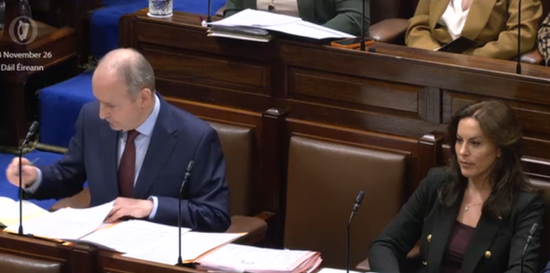
Leaders’ Questions begins with Mary Lou McDonald telling Taoiseach Micheál Martin that crisis and turmoil in the health service under the government is nothing new, “but the chaos that unfolded yesterday was extraordinary and unprecedented”.
“More than 24 hours later, we still don’t have an answer from the Minister for Health to the key question: why was the HSE chief executive fired?”.
She says that when health minister Jennifer Carroll MacNeill was interviewed on Monday, she was repeatedly asked for reasons behind the dismissal, “but each time the minister refused to answer”, adding that she “hid behind the claim” that O’Connor’s firing was solely, exclusively a matter for the HSE board.
She asks Martin why O’Connor was sacked, what did Carroll MacNeill tell him, what reason has been given and what role or involvement did Carroll MacNeill have in O’Connor’s dismissal.
 Oireachtas
Taoiseach Micheál Martin says he fully accepts that decision of the HSE board to end O’Connor’s tenure during her probationary period “is a matter of public interest”.
He says that O’Connor has had a distinguished and committed career in the public service and in the private sector and acknowledges that this is personally “a very difficult situation for her”.
Martin says it is wholly within the power of the HSE board to do this and points to Oireachtas legislation that places responsibility for the appointment, performance management and removal of the CEO with the HSE board.
“Under Section 16 of the Act, the board is specifically required to establish and implement arrangements for the management of the performance of the CEO, and the CEO is appointed by the board under Section 21A, and the appointment itself is a matter for the board.”
He says Section 21B of the Act expressly provides that the board may, at any time, remove the CEO from office where, in its opinion, the removal of the CEO is necessary for the effective and efficient performance by the HSE of its functions.
The legislation does not require ministerial approval before the board exercises that power, and where the board removes the CEO under Section 21B, it is required to provide the CEO with a statement of reasons for the removal, he adds.
Martin adds: “Fundamentally, it is a matter for the board and not for the minister, and that is just the legal statutory reality of this. And that’s a very important point that people would not want to accept, but there is no other alternative to that truth and that reality.
“While the minister may be informed of the board’s decision, the decision itself is one vested by law in the board.”
The Taoiseach goes on to read some of a statement that he says the HSE board provided to Minister for Health Jennifer Carroll MacNeill.
It says that the HSE board agreed a set of performance objectives with the CEO following her appointment in March 2026 and progress against these objectives was monitored throughout the year through regular board and committee oversight, performance reporting, with a formal review in June and October 2026.
The statement says the board met on 19 November “and unanimously concluded that the removal of the chief executive officer was necessary to effective and efficient performance by the Health Service Executive at its functions and decided to remove her from office”.
The Journal / YouTube“Fascinating” is how Mary Lou McDonald describes the statement, adding that it reads as though a person who has been in a post for seven months “is to be the fall guy or gal for that list and litany of failures in the health service”.
The Sinn Féin leader says it is “astonishing” that the HSE board would take the “extraordinary, unprecedented decision” to dismiss O’Connor after a few months and that the real accountability has to come from the government and the minister.
I put it to you that this is a charade. I put it to you that the minister had an involvement in this turn of events, and I put it to you that anyone with an ounce of common sense will not buy the story that you are spinning.
Martin hits back by accusing McDonald of spinning things and that he is simply laying out the facts of the situation.
“I laid out the statutory reality, which is uncomfortable for you because it doesn’t allow for exploitation of it for political purposes,” he says.
Returning to the statement of the HSE board, he points out that it states that the decision to remove O’Connor was unanimous and was based on its assessment of her performance and leadership over a period of nearly eight months “and was not the result of any single event or issue”.
Political Editor Christina Finn here.
Leaders’ Questions kicked off with the Ceann Comhairle giving a warning to members to be respectful and to listen to each other’s contributions, without interruption.
Sinn Féin’s Mary Lou McDonald begins by saying that “it is an absolute shambles” how the sacking of HSE boss Anne O’Connor has been handled.
She said nobody believes the HSE boss would be sacked without the involvement of the minister or the government.
The Taoiseach acknowledged that it is a matter of public interest, but has firmly said it is “wholly in the power of HSE board” to terminate O’Connor’s contract.
“Fundamentally it is matter for the board and not for the minister,” he said.
McDonald said O’Connor is the “fall gal” for of a litany of failures in the health service.
“I put it to that this is a charade,” she said, adding that anyone with an “ounce of common sense will not buy the story that you are selling”.
Meanwhile, Social Democrats deputy leader Cian O’Callaghan said the sacking of the HSE boss is “seismic”.
“People need to know what happened and why,” he said.
This kind of questioning was repeated by Labour leader Ivana Bacik.
My reading so far: Other than the statement read out by the Taoiseach from the HSE board, the specifics have not been laid out to the House as to what specifically O’Connor failed to achieve in her nine months in the job.
Martin has also yet to outline the timeline of who knew what when.
 Oireachtas
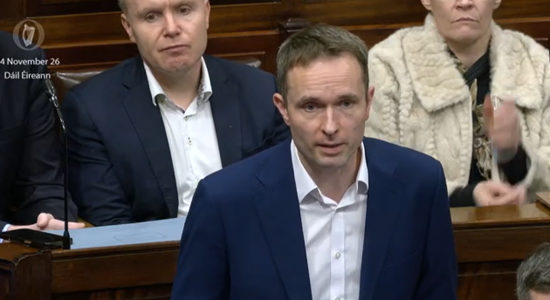
Social Democrats deputy leader Cian O’Callaghan says O’Connor has been sacked at a time when over a million people are on hospital waiting lists and 673 are stuck on trolleys.
“The HSE is in utter chaos under your watch, and the Minister for Health is ducking for cover,” he says, before going on to criticise Carroll MacNeill for not sharing more information about O’Connor’s removal.
He says the minister must answer questions about the matter before the Dáil.
Micheál Martin points out that Carroll MacNeill will be before the Oireachtas Budgetary Oversight Committee this afternoon where she “is willing” to make a statement and take questions. She will also be before the Health Committee on Wednesday.
He reiterates the HSE board’s statement that the decision to dismiss O’Connor was based on its assessment of performance and leadership over a period of nearly eight months since the CEO commenced employment and was not the result of any single event or issue.
The statement from the HSE board that Taoiseach Micheál Martin has been quoting from during Leaders’ Questions has been published.
This is it in full:
The HSE Board agreed a set of performance objectives with the CEO following her appointment in March 2026. Progress against these objectives was monitored throughout the year through regular Board and Committee oversight, performance reporting, and formal review in June and October 2026.
The Board met on 19 November 2026 and unanimously concluded that the removal of the Chief Executive Officer was necessary for the effective and efficient performance by the Health Service Executive of its functions and decided to remove her from office.
Background
The decision to terminate the employment of the Chief Executive Officer was taken by the HSE Board in the exercise of its statutory responsibilities under the Health Act 2004, as amended.
The CEO commenced employment on 23 March 2026 under a five-year fixed-term contract that included a 12-month probationary period.
Following the CEO’s appointment, the Board agreed a comprehensive set of performance objectives covering:
Delivery against these objectives was monitored through:
The Chairman advised Minister of the process in September 2026.
At its meeting on 19 November 2026, the Board formed the opinion that the removal of the CEO was necessary for the effective and efficient performance of the HSE’s functions.
Background to the Board’s Decision
The Board’s decision was based on its assessment of performance and leadership over a period of nearly eight months since the CEO commenced employment and was not the result of any single event or issue.
Board Decision
At its meeting on 19 November 2026, the HSE Board formed the opinion that her removal was necessary for the effective and efficient performance of the HSE’s statutory functions and resolved to terminate her employment.
In accordance with its statutory obligations, the Board notified the CEO of the reasons for its decision.
 Oireachtas
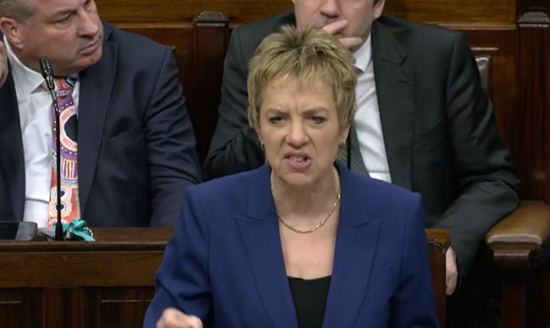
Labour leader Ivana Bacik tells Micheál Martin that until he got to his feet to speak at 2pm, nobody knew why Anne O’Connor had been sacked.
“Not one minister had spoken to the media this morning. The only minister willing to put her head above the parapet was your own minister, Norma Foley, and the board of the HSE has only just now, it seems, issued a statement,” she says.
Bacik refers to O’Connor’s own statement that her dismissal was carried out “in an abrupt and precipitous manner” and says the HSE board’s statement raises more questions than answers.
She also points out that the set of performance objectives makes no reference to patient safety. “It seems that the board of the HSE have placed cost containment over patient safety in setting out criteria for making this extremely drastic decision,” she says.
The biggest question of all: where is the health minister in all of this? Was she just told on Saturday evening? That’s extraordinary. I don’t think any of us believe that.
Bacik says Carroll MacNeill has been “extraordinarily activist when it suits her” and at times engaged in “inappropriately micromanaging” certain aspects of the health service by “reversing previous efforts to decentralise the health service” and “power grabbing when it comes to budgets”.
But she questions how she was “remarkably disengaged in relation to this drastic decision at a time when the health service is in crisis”.
In response, Micheál Martin says the HSE board has made it clear that O’Connor’s dismissal came after an eight-month process during a probationary period.
He refers to Bacik’s contribution in the Dáil last week, where she said that “official Ireland” — including the government and Anne O’Connor — has been engaged in what “looks like a witch hunt” of CUH boss Jennifer Kearney.
He says Labour “can’t have it both ways”.
“Your deputies behind you, who would have interrogated the CEO of the HSE last week, I think were fairly forceful and robust, but that had nothing to do, it seems to me, with the decision of the HSE board, who have made it clear that it was not in relation to any one issue or any one event.”
Referring to Bacik’s assertion that cost containment trumped patient safety, he says “under no circumstances is that correct” and states that the HSE works with HIQA, the National Patient Safety Office and chief clinical officer Colin Henry to “prioritise patient safety all the time”.
He adds that health outcomes have dramatically improved over the last decade amid huge investment in health and refers to several improved outcomes in mortality rates for certain conditions.
Bacik says it’s “utterly perverse to sack the head of the HSE at a time when you’re saying that outcomes are so much better in health, that we’re seeing so many improvements”.
Pointing to budget overruns in the health service, she says “if that was really the case, if that was the reason for the sacking, every CEO of the HSE ever would have been sacked”.
“Furthermore, you sacked the CEO in the same week that you put forward a supplementary budget to the very person to respond to that supplementary budget.”
Martin says the government didn’t sack anybody. “Those are the facts, and you know it. Your background is law. You lecture in law. So you know what I’m saying is true.
“The board is the only entity that can remove a CEO from office,” he says. “Do not try and say government sacked someone when government did not and could not and could not be involved in it.
That doesn’t suit the opposition narrative, because of course you want to paint it all together and say all of that. That is the reality, deputy. That is the reality. The board took a unanimous decision itself to end the tenure of the CEO.
It’s worth noting that when Leaders’ Questions wrapped up and it came to TDs agreeing the order of business, Sinn Féin, the Social Democrats, Labour, People Before Profit and Independent Ireland called for Health Minister Jennifer Carroll MacNeill to come before the Dáil and answer questions about the dismissal of Anne O’Connor.
Chief whip Mary Butler responded by saying Carroll MacNeill would be before the Oireachtas Budgetary Oversight Committee at 3.30pm.
“I will discuss with the minister her availability to come before the house, but the order of business stands in relation to discussing the finance bill this afternoon and tomorrow afernoon.”
Jennifer Carroll MacNeill will be appearing before the Oireachtas Budgetary Oversight Committee in around 15 minutes.
That gives you just enough time to listen to this week’s episode of The Explainer, which sees our political editor Christina Finn discussing – surprise, surprise – the sacking of Anne O’Connor.
Fórsa has also called for an explanation from the Minister for Health over O’Connor’s dismissal.
The trade union, which represents 40,000 clinical and administrative workers in health services, said her removal “illustrates continuing chaos in the management of our health services and risks further undermining confidence in those services”.
In a statement, Fórsa’s general secretary Kevin Callinan said Jennifer Carroll MacNeill “must explain why the HSE’s chief executive was so suddenly removed from her post”.
“To begin rebuilding confidence and trust, the Department of Health, the HSE and its board must then account to staff and service users for where our health services go from here. The chaos must end,” he said.
 Pádraig Rice. Alamy Stock Photo
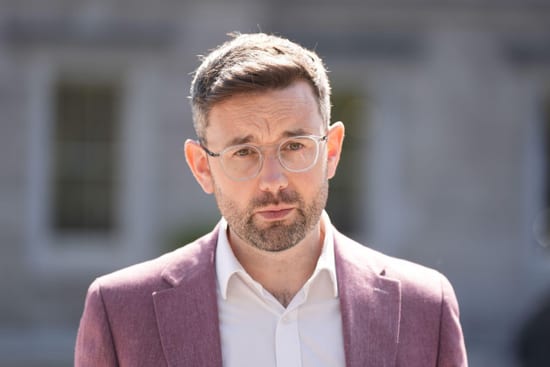
Social Democrats health spokesperson Pádraig Rice has said the statement from the HSE board about its decision to sack Anne O’Connor “raises more questions than answers”.
He has called for the chair of the HSE board to come before the Oireachtas Health Committee “as soon as possible”.
“The statement from the Board today states that Ms O’Connor was subject to a comprehensive set of performance objectives when she was appointed,” Rice said.
Referring to the “laundry list of objectives” set out in the statement, he said:
Given Ms O’Connor was hired as a CEO and not a magician, it is unclear how the Board expected Ms O’Connor to tackle all of these objectives in just the eight months she was in situ.
He said it is also unclear if every other HSE CEO was subjected to this performance management system, adding that while it’s normal for CEOs to have targets and objectives they are working to, they are usually given time to meet them.
“The Board has listed the metrics Ms O’Connor was adjudicated on, but has not told us what specific targets she was expected to meet or which of those objectives she breached,” he continued.
Rice, who chairs the Oireachtas Health Committee, said the board is also coy on any conversations or briefings it had with the minister, simply stating that she was informed of “the process” in September.
“However, the Minister had written to the Chair of the Board in May this year expressing trenchant criticism with the scrapping of a daily meeting on the trolley crisis in hospitals – a meeting which was eventually reinstated in September.
“Are we expected to believe that there was no formal, or informal, conversation with the Minister at that point about these performance objectives? And, if not, why not?”
Rice also noted that Carroll MacNeill “seized power from four HSE regions for recruitment in September – something which exacerbated the overcrowding crisis”.
“This raises questions about whether Ms O’Connor was being judged on things she had no control over.”
He said the statement also makes no reference to the controversy surrounding CUH, which implies it had nothing to do with the decision to remove O’Connor.
“None of this is credible. Big questions remain unanswered – including, whether it was the Minister, and her dissatisfaction with Ms O’Connor’s performance, that put these events in train.”
 Oireachtas
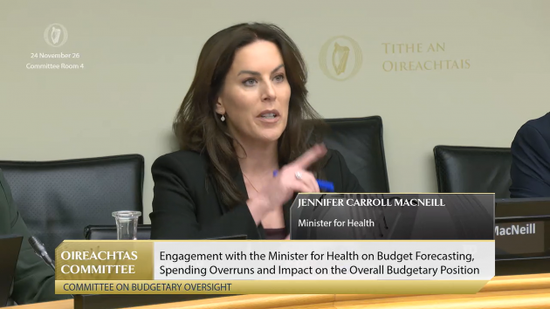
The Oireachtas Budgetary Oversight Committee is in session, and Minister for Health Jennifer Carroll MacNeill is making her opening statement.
She opens by saying she is there to discuss budget forecasting, but notes that she is “very aware that deputies will want to discuss other matters also, which is very appropriate”.
She says that while she had said it would not be appropriate for her to speculate on the decision to dismiss Anne O’Connor, the HSE board’s statement that was published around an hour ago allows her to speak about the matter.
Carroll MacNeill says O’Connor has given many years of public service and she wants to thank her and wish her the very best for the future.
Deputy chief executive officer Damian McCallion has taken up the role of interim CEO and the HSE board will communicate the process of recruiting a new CEO “shortly”, she says.
“I continue to work with Damien and all his colleagues to ensure that patient care and patient safety are at the forefront of everything we do in our health services.”
 Oireachtas
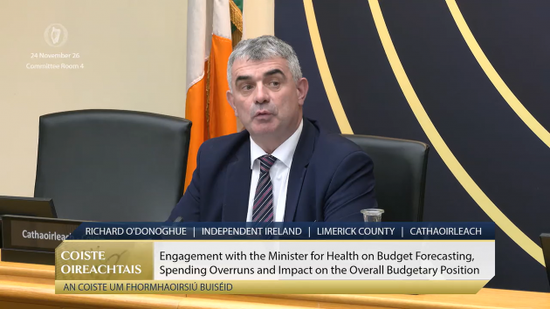
Committee chair Richard O’Donoghue begins questioning by saying that he is not going to get into the matter of Anne O’Connor’s dismissal because there could be legal implications.
“My problem is everything that is in your opening statement is something that a CEO should be dealing with, and a CEO should be dealing with or supporting everything that you mentioned in your statement, and that didn’t happen,” he says.
In a long introduction without a question being asked, he tells the minister that the biggest concern he has over budget oversight “is there seems to be no budget, and it’s overrun, and it seems to be going into the wrong places, and it’s not going into the services being delivered”.
O’Donoghue says it appears there is no accountability for error in the health service, adding: “They are either promoted or shoved aside, and the problem is not dealt with.”
He says he wants a commitment from the minister that “for any position going forward in your department, if the person in that position cannot deliver, I want them removed from that position, and I want to put in people in that position that will deliver and work with everyone in this room”.
Carroll MacNeill says the healthcare system is “broadly very good” and well-recruited.
“Everybody here is concerned for their constituents to have access to a good healthcare system, that means making sure that waiting times are reduced. That when people need procedures, that they happen. That when they present to an emergency department, that they’re able to be seen quickly and treated quickly and admitted to the hospital.”
There’s no real answer to O’Donoghue’s question before the time is up.
 Oireachtas
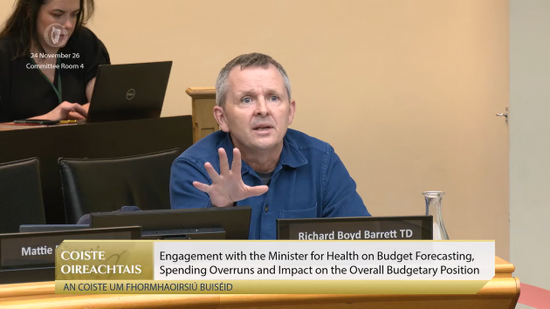
People Before Profit’s Richard Boyd Barrett is next. He says that what TDs and senators are hearing from the government lacks credibility.
“Do you honestly believe it is credible to tell us, as the Taoiseach did today, that the minister has no responsibility when we have the unprecedented sacking of the head of the HSE?
“But only a few weeks ago, you said effectively that you didn’t trust the HSE to do recruitment to the health service. So it’s okay for the HSE to sack people, and you know nothing about it, but it’s not okay for the HSE to recruit people when we are facing a catastrophic situation where the nurses, health workers, consultants are saying we’re chronically understaffed in our health service, and you seem to be disputing that?”
Carroll MacNeill says she asked the HSE in October to identify any post within the system that would either enhance patient safety or patient flow processes throughout the hospital systems. She said 390 positions were identified and weren’t progressed throughout the last number of weeks.
She said she asked Damien McCallion yesterday to get those positions to the department as a matter of absolute priority.
“I proactively asked the HSE to prioritise that, so recruitment is still very possible. We’ve had graduate nurses approved. We have a significant number of agency conversion posts being approved.”
She says since 1 January, there are 4,000 new people in the health system.
Boyd Barrett interjects to say that the fact that there are supplementary estimates is either because of bad management by the HSE, “or because you haven’t given them enough in the first place”.
“What we’re being told by the doctors and the nurses and the people who actually deliver front line stuff is you’re not giving them enough in the first place.
“That the problem, and really it’s beginning to look like the HSE are the fall guy for government failure to properly fund and resource the health service and recruit the permanent staff that we need, and then we end up having to pay the money out to the private sector.”
 Oireachtas
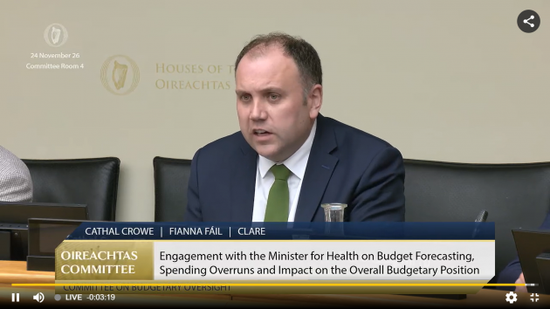
Fianna Fáil’s Cathal Crowe now has the floor, and he’s looking back to the 1700s.
“We’re still trying to all get our heads around this, and there’s a lot in the news today, and there’s a lot in briefing notes. It’s a little bit French Revolution-esque, if you don’t mind me saying so,” he tells Jennifer Carroll MacNeill.
The Clare TD says the head of the HSE is now gone and questions what happens next. He says there are “fantastic” people working in senior positions in the health service around the country who would make great leaders.
He says what followed the French Revolution was a reign of terror and paralysis in terms of decision-making.
“Could this lead to a point where those best and brightest people who are supposed to be reforming the health service now fear they can’t take these budgeted decisions, or they’re some way paralysed in decision-making because someone above them has already got the chop? And could they be next?”
Carroll MacNeill responds: “I don’t believe so, deputy.”
She says there are contractual processes in place for every single person in the HSE and that “whether you work in a bank or in an energy company”, everybody has employment contracts, protections and responsibilities.
“As the chair has said, and as others have said, it is important that those can be exercised from time to time,” she says.
Crowe refers back to Carroll MacNeill’s opening statement in which she said four regions are in an overspending scenario. He asks for a commentary on “who’s best in class and who’s overspending” and which ones have raised red flags.
The health minister says it’s very clear that the different regions have delivered differently.
She says Dublin North East and the Midwest have come in within 2%, which is “essentially within budget”, while the West/Northwest was at about 2.6%, “but that is trending downwards and may get to that 2%, which would be good”.
She says Dublin Midlands has a very significant dependence on agency posts, which have been “extremely expensive”, but they have now a programme of agency conversion where “hundreds” of agency posts will be able to be converted into permanent staff.
“There’s a similar profile in Dublin South East, and then the South West has recruited way beyond its profile in many different ways.”
 Oireachtas
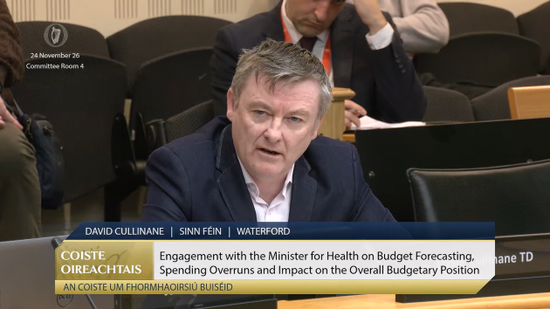
Up next, Sinn Féin health spokesperson David Cullinane. He asks Carroll MacNeill when she was first made aware that the board had dismissed Anne O’Connor and was it verbally or in writing.
Carroll MacNeill says that on the morning of Thursday, 19 November, the chair of the board updated her secretary general to say that the board was meeting that afternoon to discuss O’Connor’s performance as part of its ongoing review.
She says that evening, the board chair called to advise the department’s secretary general that the board had reached a decision to end the tenure of the CEO’s contract and that he would be conveying that decision to the CEO as soon as practicable.
The secretary general then told Carroll MacNeill about the decision.
She says she then went to the Attorney General “to determine what I should do and how I should communicate or not communicate or what steps I should take as Minister in relation to the rest of the government”.
“His view was that in order to allow the process to be completed and to protect the privacy of the CEO and that process, that I should do nothing and I should wait for the process either being completed or to wait the next stage and to wait to be informed formally by the chair in writing.”
She says she was advised formally in writing by the chair of the HSE board about its decision on Saturday evening.
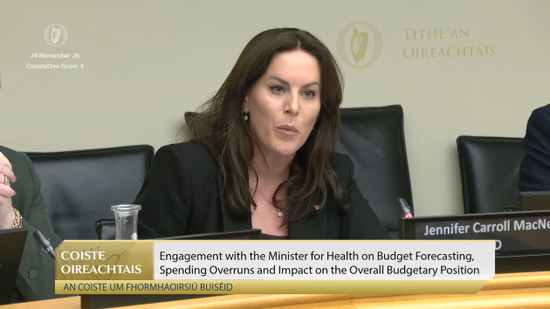
Our political correspondent Jane Matthews reports that the Oireachtas Health Committee has agreed to invite the entire board of the HSE before it next Wednesday.
Minister for Health Jennifer Carroll MacNeill is before the committee on Wednesday and she will be asked to come back on Thursday for a joint meeting.
“I would encourage the members of the HSE Board to attend the Health Committee next Wednesday,” committee chair Pádraig Rice said.
“The statement released by the Board earlier today raised more questions than answers. We need clarity from them about why the unprecedented step of sacking the HSE CEO was taken.”
 Oireachtas
Carroll MacNeill says she was verbally advised in September about the process that was put in place to evaluate O’Connor’s performance.
Cullinane asks her if she expressed an opinion about her performance.
“No, because I have a background in employment law and I knew immediately that that was a point of separation for them to have their process,” she says.
She says the verbal update in September was that the board was moving into a more escalated process in terms of its performance review of the CEO.
Cullinane asks: “So you understood that there were serious concerns back in September?”
“That’s my understanding,” Carroll MacNeill says.
Cullinane asks: “Did you have any conversation prior to that verbal exchange in September with anybody on the board about the CEO’s position?”
The health minister says she did not have conversations about the CEO’s position or the process that was put in place, but that she would have communicated her opinion “in relation to the HSE’s performance on urgent and emergency care financial controls”.
Cullinane then asks if she ever had a conversation with O’Connor about performance.
“[O'Connor] said she was shocked. This was a bombshell. She was expecting to go down to Cork University Hospital on a Monday. She’s sitting there in her house, I assume, or wherever she was on Saturday. She gets this call. She had spoken to you a week before. She had no idea this was coming, and at no point had you had a conversation with Anne O’Connor about her own performance, even though you knew that there was very serious issues that you recognised there were being escalated?”
Carroll MacNeill says: “Knowing that somebody was in a performance process made it even more important that that not be a conversation that I engage in.”
But she says that all of different metrics by which the HSE is performing or not performing “would have been an ongoing conversation that I have all of the time”.
When Social Democrats deputy leader Cian O’Callaghan asks Carroll MacNeill about the reason for the HSE board dismissing O’Connor, she says she can’t speak to that because she was not involved in the process.
“I don’t have any documents from the board, nor have I had any conversation about the specifics about their performance management process,” she says.
“What I do know is that they had performance objectives from the earliest point, tat they had a series of performance meetings throughout the period of Ms. O’Connor’s tenure, and that they ultimately entered an escalated performance management process at some point in September.”
Labour’s Marie Sherlock tells Carroll MacNeill that she doesn’t find it credible that she does not know the reasons why Anne O’Connor was dismissed.
“Look, I understand what you’re saying and why you’re saying it. However, what I would say is, if I were to be given a list of reasons, or if I had knowledge of that, that goes beyond normal employment law processes,” Carroll MacNeill responds.
Jennifer Carroll MacNeill confirms that Andy Phillips is still in his position as HSE South West regional executive officer.
Phillips was named in the media amid controversy surrounding Cork University Hospital (CUH) earlier this month, after safety concerns at the hospital were raised publicly in August when a letter from CUH CEO Kearney to senior HSE officials made its way to the media.
Following the release of that letter, a meeting held between Kearney and Phillips, and other senior staff at CUH, was held, which was later revealed to be recorded.
It was reported that Phillips told Kearney that he had been “instructed by the Taoiseach’s office and the Minister for Health’s office to have some very specific conversations with you”.
But in the Dáil during Leaders’ Questions, the Taoiseach denied this was the case, and said that “false assertions” were made about his office. The Irish Times published the recording of the meeting on its website earlier this month.
The audio recording subsequently clarified that the Taoiseach’s office had been referenced in the meeting. Phillips also made reference to performance reviews being carried out on Kearney and hospital management.
Anne O’Connor told the Oireachtas Health Committee last week that Phillips had explained that the comments were made in the heat of the moment during his meeting with Kearney.
Asked by Marie Sherlock if she supports Phillips continuing in his role, Carroll MacNeill says:
Again, I need to leave that to employment law and performance management and personnel management processes within the HSE.
“I know Anne O’Connor spoke in part to that last week, but that really is important. It is not for me to manage individuals. It is for the HSE as an employer to manage any individual, whether that’s the manager of a hospital, whether that’s an REO, whether that is any person in the health system. Not the minister for health.”
 Oireachtas
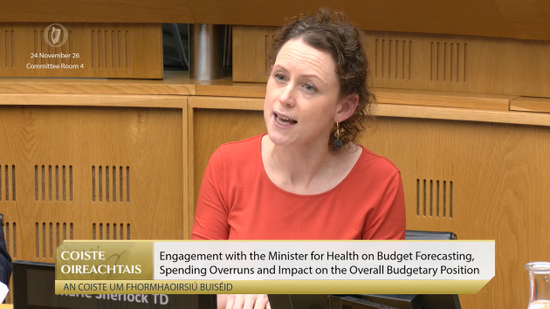
Marie Sherlock says the HSE board said in its statement that the removal of O’Connor was necessary for the effective and efficient performance by the Health Service Executive of its functions.
“It didn’t say that it needed to replace her. It said it was necessary to remove her,” she says.
“What decisions were ineffective and inefficient? Can you specify that? And what was Anne O’Connor doing that Bernard Gloucester did not do? Or conversely, what did Bernard Gloucester do that Anne O’Connor was not doing?”
Carroll MacNeill says they need to be careful “because we’re speaking now about individuals who aren’t here”.
Committee chair Richard O’Donoghue interjects to reprimand Sherlock, telling her: “If you were here for the briefing before the meeting, you would have known what questions that you could ask and couldn’t ask.”
Carroll MacNeill reads from Section 21B of the Health Act 2004, which she says provides that the board may, at any time, remove the CEO from office where, in its opinion, the removal of the CEO is necessary for the effective and efficient performance by the HSE of its functions.
“The decision as to that is a decision for the HSE board, and it would not be proper for me to either have the direct knowledge of exactly what the calibration of that decision, nor even if I did, to articulate that in respect of a private individual.”
The committee has taken a sos beag to allow members to go to the Dáil chamber, where a vote has been called.
 Oireachtas
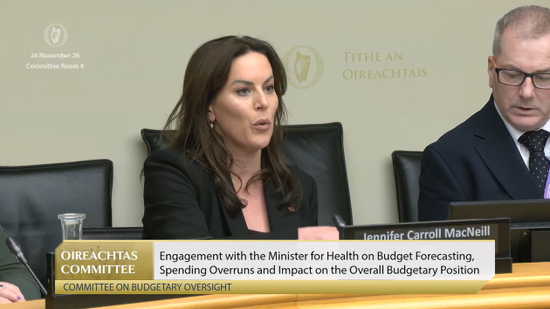
We’re back, for the little time the committee has left.
Sinn Féin’s Johnny Guirke states that O’Connor is not the first HSE CEO to oversee a spending overrun, and asks why she was sacked when her predecessors were not.
Jennifer Carroll MacNeill once again states that she can’t speak to the specific reasons as to why the HSE board made the decision that it did.
“We have further information from the board about how they manage performance, agreed performance objectives versus performance over the year.
“That includes financial management and expenditure control, that includes urgent and emergency care performance, that includes waiting lists, a whole range of different metrics. But I can’t speak to that specifically, because it is properly a question for the board as to how it reaches its decision.”
She says she engages with all the time throughout the year with the HSE at different meetings with different people, “and the conversation that we have is an ongoing one throughout the year in relation to the financial difficulties, the urgent and emergency care performance”.
“But those are very different things to discussing any individual’s particular employment role as such. But those are the conversations that you would naturally and properly have as Minister for Health with every representative.”
Guirke asks if she was consulted before the decision was made to sack O’Connor and what discussion was had if so.
She repeats that the reason for her dismissal is a matter for the HSE board.
“I’ve set out the fact that I was notified that a board meeting would take place on Thursday, and I was notified as to the outcome. Discussions wouldn’t have been appropriate.”
She says that if, at that point, she spoke to a member of the board and said she thought this was the correct or incorrect decision, “that would be, very definitely, political interference in a process, without question”.
“What I did do was take Attorney General advice as to what I should and shouldn’t do in the next period, and how I should communicate what the board had informed me, and then… I was formally notified in writing of the execution of the decision of the board. They’re quite different things.”
Carroll MacNeill is then asked if she had any involvement “in initiating, encouraging, supporting or approving the dismissal of the head of the HSE”.
“All year long, I would have highlighted concerns in relation to pay, in relation to urgent and emergency care. Some of that I’ve seen has been FOI’d, and in newspapers where I would have written to the board expressing my concern about urgent and emergency care,” she says.
“I would have met the board about urgent and emergency care throughout the different year, but it’s not for me to express opinions about a role.”
She adds: “When you look at this overall, I respect what the board has done, and I also respect that it has been through a process with the CEO that I’ve not been part of. My overall objective is the effective running of the health system.”
The minister says she respects what the board has done and she’s sure that this is not their preferred outcome, adding: “This is not my preferred outcome.”
Aontú leader Peadar Tóibín has asked the health minister the question of the hour: “Are you aware of all of the reasons why Anne O’Connor was sacked?”
Carroll MacNeill says she’s aware by way of the statement of the HSE board and reiterates its main points to the TD.
“That is very generic,” Tóibín says.
“I have to give the answer that the board has given.”
“Are you not curious yourself that a person in a job just seven months on a ship that is very difficult to turn around would be let go on such a generic statement?” Tóibín asks. “The people listening at home are your employers, and they’re also the employers of the board, and they haven’t been told why Anne O’Connor has been let go.”



have your say