Sign in. It’s quick, free and it’s up to you.
An account is an optional way to support the work we do. Find out more.
Sign in. It’s quick, free and it’s up to you.
An account is an optional way to support the work we do. Find out more.

IN AUGUST 2024, a short clip circulated online claiming that Reporters Without Borders (RWB) had discovered widespread sympathy for Nazism among Ukrainian soldiers fighting against Russia.
It featured the BBC’s iconic logo in its top-left corner and relayed the story through white captions over grainy images of troops from the front and blurred helmets with SS badges.
As the video cut briskly through grainy frontline stills, its authoritative BBC watermark and crisp white captions seamlessly mimicked a legitimate news dispatch, claiming RWB had uncovered 1,000 cases where combatants had donned Nazi symbols and that the group had called on other media organisations to cover the story.
But this was not a legitimate BBC report, and RWB never made such a finding.
In a subsequent investigation, the press-freedom group found that the clip was an example of literal fake news promoted by pro-Russian accounts on X and Telegram.
Their report said the video was initially posted by an anonymous account on X called ‘Patricia’, but that one of the first people to pick it up and amplify it was Irishman Chay Bowes.
From there, it went viral across a network of Russian propagandists and the country’s foreign embassies, and was mentioned at a press conference by Maria Zakharova, the official spokesperson for the Russian Foreign Ministry.
Bowes – who first entered the public eye as the whistleblower in the 2020 Leo Varadkar GP contract leak before co-founding The Ditch website – now works for Russian state broadcaster RT and was among 30 individuals sanctioned by the European Union this week.
Announcing the sanctions, the Council of the EU described Bowes and three other media figures as “propagandists”, saying they had participated in information manipulation and spread narratives “that legitimise and sustain” Russia’s war against Ukraine.
Under the measures, Bowes’s EU-based assets are frozen and EU citizens and companies are banned from providing him with funds. He is also prohibited from entering or transiting through EU member states, though this doesn’t include Ireland.
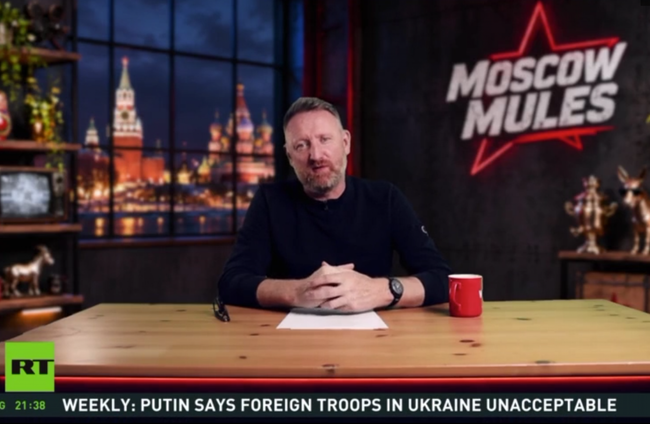
In justifying the sanctions, the council pointed to his work hosting the RT programme “Moscow Mules”,alongside his co-founding of the pro-Russian disinformation network The Islander News.
It also cited his participation in influence operations run by the Wagner Group-founded Foundation to Battle Injustice, as well as his “spreading of anti-Western and anti-Ukraine disinformation” during a 2023 appearance at the UN Security Council on Russia’s behalf.
It said that through these activites, he was “facilitating actions or policies attributable” to the government of Russia which “undermine or threaten democracy, the rule of law, stability or security” in the European Union.
Bowes criticised the move on social media as anti-free speech and an attempt to “bully me into silence”, while People Before Profit TD Richard Boyd-Barrett also labelled it “a sinister development”.
In a brief response to queries from The Journal this week, he said that he considers the sanctions to be “illegal and utterly baseless” and described allegations that he had spread disinformation on behalf of Russian groups as “false”.
Bowes and his defenders have framed the sanctions as an attack on press freedom.
Critics such as People Before Profit have warned that penalising commentators without a trial creates a dangerous slippery slope for free expression, likening it to US sanctions against UN Special Rapporteur for Palestine Francesca Albanese.
The EU though believes its decision is justified following a years-long trail of fabricated stories and Kremlin-aligned disinformation about the war in Ukraine.
Bowes’ journey raises questions about how a figure who first made his name scrutinising Irish politics became such a prolific amplifier of Russian government talking points in the West.
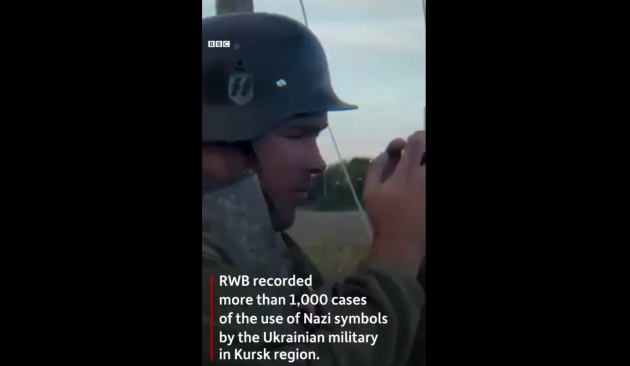 A still from the fake BBC News clip X.com
To understand how a Dublin-born businessman ended up on an EU sanctions list alongside Russian state operatives, it helps to trace a career built on continuous reinvention – one that began not in Russia, but in the Irish medical sector.
Long before Bowes began broadcasting from Moscow, he came into the Irish public’s consciousness as a healthcare entrepreneur turned whistleblower.
In 2017, he co-founded Community Hospital Ireland, a private company that provided healthcare in patients’ homes and reinvested profits into treatment for chronic illness.
The venture brought him into contact with Galway doctor Maitiú Ó Tuathail, then president of the National Association of General Practitioners (NAGP), a now-defunct union for GPs.
The relationship brought NAGP support to CHI, and by 2019, the two were close enough that Ó Tuathail felt comortable sending Bowes a message that showed he had obtained a confidential GP contract between the government and the Irish Medical Organisation.
The young doctor had received a copy of the contract from an acquaintance, then-Taoiseach Leo Varadkar, boasting to Bowes about how he acquired it in a text message: “To be fair, Leo always delivers.”
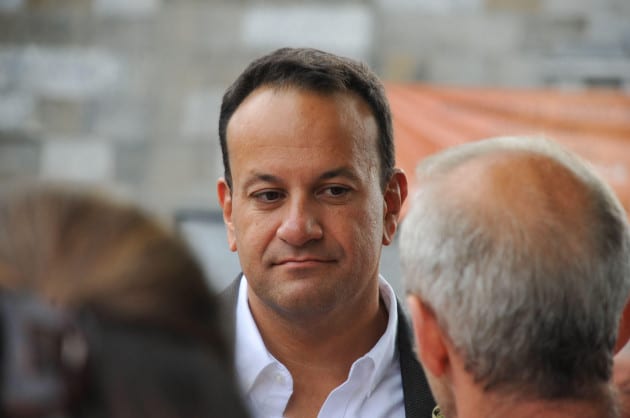 Leo Varadkar become embroiled in controversy after Chay Bowes revealed he had leaked a GP contract Alamy
Through Web Summit founder Paddy Cosgrave, Bowes teamed up with Village magazine, which published what became known as the ‘Leo the leak’ exposé in 2020 – much of it relying on Bowes’ text messages and documents.
“I was dumbfounded that a friend of the then-Taoiseach was claiming such professional closeness to him that he would improperly forward him potentially explosive confidential documentation,” he told the magazine at the time.
The ensuing political controversy earned Bowes genuine goodwill among a cohort of Irish readers as someone who had helped reveal how the most senior figure in the government did a secret favour for someone in his personal inner circle.
The following year, Cosgrave invited Bowes and Village editor Michael Smith to the stage during the opening of the Web Summit in Lisbon and urged the audience to give them a round of applause.
“@BowesChay spoke on stage at @WebSummit about @LeoVaradkar after which a long line of Irish people queued up to shake his hand,” Cosgrave gushed on Twitter afterwards.
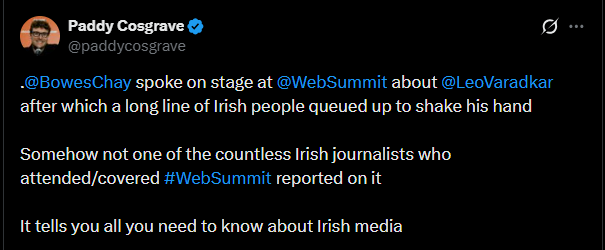 Paddy Cosgrave's tweet about Chay Bowes at the Web Summit X.com / @paddycosgrave
The episode exposed a combative streak that defined Bowes’s early public life: a readiness to sever personal alliances so that he could challenge institutional power, regardless of the fallout.
The same year as his Web Summit appearance, he parlayed the profile he had attained from his involvement in the ‘Leo the leak’ story by co-founding investigative website The Ditch, alongside journalists Eoghan McNeill and Roman Shortall.
The venture, which initially received financial backing from Cosgrave, cemented his reputation as a relentless, if opportunistic, scrutineer of Irish political power given how many stories they broke about Fine Gael and Fianna Fáil politicians.
Bowes subsequently resigned as director of and sold his shares in The Ditch in June 2022, before the outlet’s reporting led to the resignations of An Bórd Pleanála deputy chairman Paul Hyde and government junior ministers Damien English and Robert Troy, the latter of whom has since returned to government.
The audience that Bowes built through his role in Ireland’s alternative and independent media between 2020 and 2022 showed his relentless appetite for challenging domestic political orthodoxy.
Soon he began to apply that same contrarian, anti-establishment lens to Western foreign policy.
As the pandemic subsided and Russia prepared to invade Ukraine, the one-time whistleblower’s attention began to shift noticeably to more geopolitical interests.
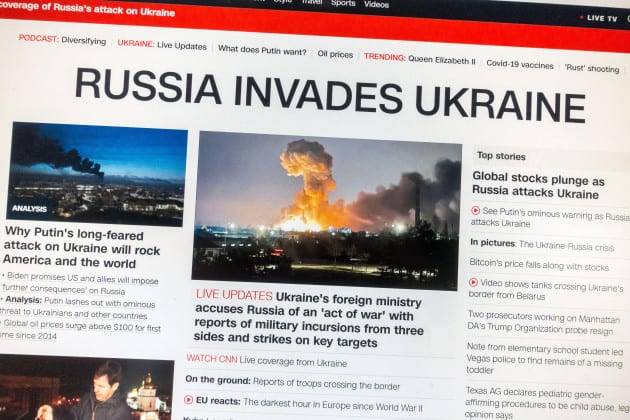 CNN's homepage on the day Russia invaded Ukraine in February 2022 Alamy
It was not entirely new ground for Bowes; three years earlier, he had published an essay in the Dublin-based independent magazine Cassandra Voices, taking aim at Nato expansion and criticising EU leaders seeking to absorb Ukraine into the “Western orbit”.
Returning to this theme in January 2022, a month before Russia’s full-scale invasion, he published another essay in which he argued that Ireland – due to its history of partition, ethnic division, and proximity to a powerful neighbour – is uniquely positioned to understand the complexities of the Ukraine-Russia conflict.
He presented the looming conflict through the prism of a crisis rooted in the expansion of Nato and a failure to recognise Russia’s legitimate security interests.
“It is simplistic to cast Russia as a deviant nation hellbent on suppressing and oppressing its neighbours, particularly those previously a part of the Soviet Union,” he wrote.
“The truth is far more complex.”
Yet in February 2022, Bowes’s initial reaction was notably equivocal on what was unfolding at Europe’s eastern border.
When Russia invaded Ukraine in the early hours of 24 February 2022, he took to Twitter to say he didn’t accept the country’s actions or find them acceptable.
His criticism was couched in qualified support for Ukraine (“I am 100% against any action [...] that causes loss of life”) and posts that took as much aim at Nato and the United States as they did at Russia.
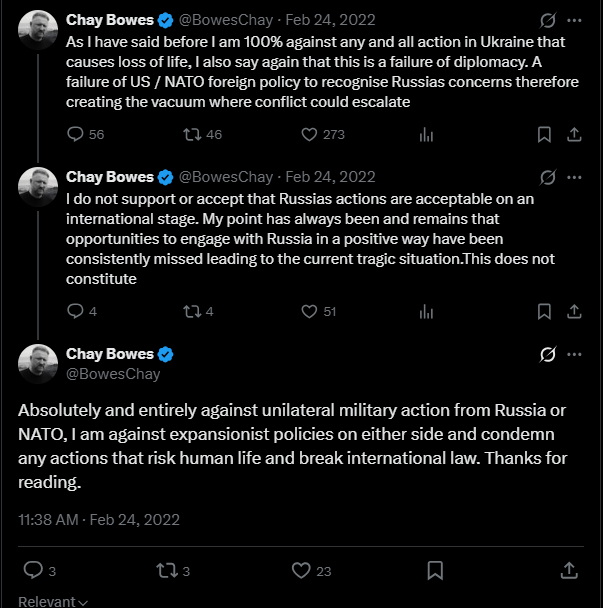 Bowes Twitter thread from the morning of 24 February 2022 X.com / @BowesChay
There were also times when his criticism of Russia was more categorical.
At one point early in the war, he described what was happening as “immoral” and said that Russia had carried out an “illegal and brutal invasion” that was leading to the “murder” of Ukrainian citizens.
“This entirely unacceptable and unnecessary war in #Ukraine is entirely unjustified and unjustifiable,” he posted.
It was a viewpoint that wasn’t to last.
Over the following year, Bowes’ Twitter feed shifted incrementally from condemning Russia to questioning Western support, moving first through amplification and selective framing rather than fabrication.
In May 2022, he shared a Bloomberg opinion column asking whether then-UK Prime Minister Boris Johnson was prolonging the war; in January 2023, he cited a genuine US State Department human-rights report in a post that argued against funding and arming Kyiv.
Even on 31 August 2022, he still affirmed Ukraine’s right to freedom and statehood, though he did so alongside criticism of Volodymyr Zelenskyy and claims that Kyiv was persecuting Russian speakers in the Donbass region.
Ten months on, appearing via video link at a June 2023 UN Security Council briefing, he had shed all nuance in favour of an unabashedly pro-Kremlin line.
Invited by Russia, Bowes – given the on-screen title of “scholar specialising in small arms and munitions” - addressed the UN’s highest-authority body and cast Russian troops as “defenders” and Ukraine as a “chaotic and essentially failed state”.
He used his appearance to shift blame for the ongoing bloodshed squarely onto Western capitals.
“Settlement will come, and it is my absolute belief that it is up to those in Washington DC and London, now fuelling the conflict with endless escalatory military aid to Ukraine, to decide where and when that settlement occurs, either at the negotiating table or on the battlefield,” he said.
While Russian ambassador Vassily Nebenzia publicly thanked him afterwards, the next speaker – Soviet-born British historian Sergey Radchenko – rebuked him by name.
Bowes, he said, had come to the UN chamber to lecture delegates on “how terrible it is to support a victim of unprovoked aggression, how terrible it is to help people under attack, how terrible it is to resist imperialist conquest”.
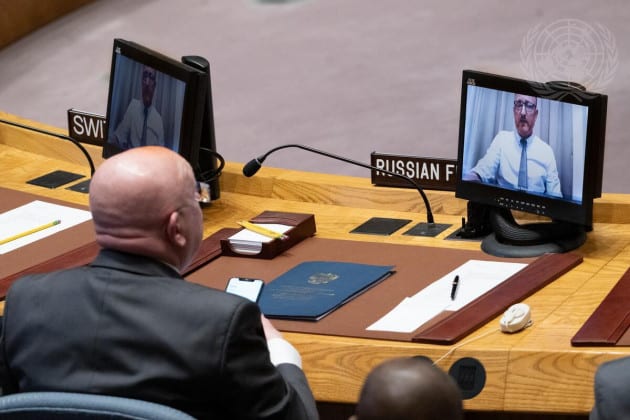 Chay Bowes appears on screen at the UN Security Council in June 2023 United Nations
By tracing Bowes’s odyssey from nuanced early reaction to the war in early 2022 to unambiguous pro-Kremlin, West-critical posturing at the UN 18 months later, one can see how his public pronouncements coincided with his changing professional orbit.
After giving up his work and shares in The Ditch in June 2022, the former whistleblower moved to Moscow in the latter half of that year to become a correspondent for RT.
Even at that stage, the state-funded outlet (previously known as Russia Today) had become an outcast in the broadcasting world on foot of Russia’s full-scale invasion of Ukraine.
Brussels sanctioned RT as a state propaganda outlet, and it was banned across the European Union, stripped of its broadcasting licence in the United Kingdom, and blocked from platforms including YouTube, Meta, Google, Apple and TikTok.
But the company gave Bowes an institutional standing and media salary, while also enabling him to continue his anti-establishment talking points against European politicians, the US and Nato.
He was not the first Western figure to take up a role with the broadcaster.
Since the early 2010s, RT has opportunistically recruited Western anti-establishment figures with offers of generous pay and editorial freedom “as a way of authenticating the messaging they want to promote”, according to Stephen Hutchings, professor of Russian studies at the University of Manchester.
Those hired were not necessarily dupes, he explains, but commentators who “saw RT as an opportunity for them to promote their agendas”.
Hutchings notes that the 2022 bans pushed RT into far more overt propaganda, blending contradictions that cast Russia simultaneously as an anti-imperialist champion, a victim of Western cultural colonisation and a great power entitled to its own sphere of influence.
“These three lines don’t really hang together, but that doesn’t matter,” he says.
“You pick whichever of those messages works best for a particular audience or in a particular situation.”
Bowes began his career with RT as a correspondent, appearing in news segments to provide his analysis of global events, in clips that were also shared on social media.
ICYMI: Pentagon Investigates Major Leak Of 'Classified Documents' Washington is alarmed after a new trove of secret US national security documents relating to Ukraine, China & the Middle East appeared online. RT correspondent Chay Bowes is in the studio to explain the events. https://t.co/AQoLHw5WRi
— RT_India (@RT_India_news) April 9, 2023
By early 2024, he had been given his own sleekly-edited weekly podcast, Moscow Mules, with targets including EU countries and their leadership, US politics, the Russia-Ukraine war, and domestic affairs in Ireland and the United Kingdom.
Alongside sleek editing, the show adopts a faux-casual, smirking register – using derisive humour as a delivery mechanism to launder hard-edged Kremlin talking points.
A recent episode called ‘The unflushed empire’ examined claims that a foreign power could be behind recent home intrusions targeting 20 members of Finland’s parliament; amid suggestions that the intruders had left behind unflushed toilets and human waste, the episode ironically dismissed the claim by calling it Operation Number Two.
The framing sought to dismiss the story as yet another attempt by the West to blame the Kremlin on even trivial things, a play that helps to undermine criticism of more globally consequential activities by Russia.
Between these instances of so-called satire, however, have been plenty of cases where Bowes has leaned into Russian disinformation narratives.
In a November 2025 broadcast titled ‘A fool and his money’, the programme suggested that Western financial support for Kyiv is a giant fraud, promising to show how “EU elites and Ukroscammers enjoy revelling in free taxpayer money”.
Framing Western military and financial assistance to Ukraine as an embezzlement scheme is one of the Kremlin’s main anti-Ukraine narratives, designed to turn EU and US citizens against supporting Kyiv and to derail the country’s EU accession.
In another episode from August, Bowes appeared on-screen beside an article from a website called the Irish Sun, reporting corruption allegations involving Zelenskyy’s staff.
Despite its name, the site is an online outlet operated by an Australian company, Midwest Radio Network, on behalf of its Dubai-based parent company, Big News Network.
It was set up in 2002 and claims to take its name from a newspaper that was published in Ireland from 1880, and explicitly disclaims any connection to the Murdoch-owned newspaper of the same name.
“Irish Sun is not associated with The Sun in the UK, or that publication’s Irish edition,” its ‘about page’ says.
Big News Network, which supplies the site’s syndicated content, is an international syndication network identified by disinformation researchers as a “pink slime” operation that republishes sanctioned Russian state media.
The Irish Sun article used by Bowes visibly credited RT.com, allowing the segment to function like a digital hall of mirrors.
Kremlin-aligned copy left Moscow via RT, passed through an Australian-owned aggregator donning an Irish masthead, and bounced straight back onto Bowes’s studio screen in Russia as apparent third-party corroboration.

The show has also repeatedly pushed the pretext for Russia’s invasion by claiming that Ukrainian state bodies are partnering with neo-Nazis and that Volodymyr Zelenskyy is an “unelected dictator” presiding over a corrupt regime.
Ukrainian volunteer militias with far-right roots like the Azov Battalion were once active in the country, but were formally absorbed into the country’s regular military structure over a decade ago.
While far-right elements persist within pockets of the armed forces, researchers note they remain a small minority rather than a state-controlling force, with one calling them a “proverbial drop in the ocean”.
Zelenskyy remains in office because Ukrainian law prohibits holding elections under martial law during a foreign invasion.
It’s an arrangement that has occasionally prompted debate inside Ukraine, but has been navigated through constitutional consensus, regular parliamentary votes, and the view that a ballot must wait until peacetime.
One episode description recently labelled Zelenskyy as the “Cocainefuhrer”, linking the claim that he is an unelected Nazi to an ongoing smear by Russia that the Ukrainian leader is a drug addict.
The misinformation spread on Moscow Mules is not just limited to the conflict in Ukraine.
In the same October 2026 episode mocking the Finnish break-ins, an episode description claimed that Met Police in London had been “traded for Sharia patrols”, reviving a long-debunked far-right trope that suggests that parts of the British capital have ceded control of their streets to Islamic religious police.
“What you definitely can’t do is drink a beer near a mosque because, of course, Islam is the national religion of the UK now,” he told viewers, introducing a clip taken from social media where a man asks a group not to consume alcohol on a street.
“Imagine a white British Christian went and complained about this type of stuff that’s also happening in the UK right now; think about what would happen [...] Six months in prison? Hate crime? Racism? Nazi? You get the picture.”
Another episode criticised USAID as US taxpayer money going “down the drain of the clogged bathrooms of transgender Colombian operas”.
It echoed a White House and DOGE talking point that cited a purported “$47,000 (€43,000) grant for a ‘transgender opera’ in Colombia” as proof of “waste and abuse” to justify dismantling USAID, though spending records show USAID gave no money to the project.
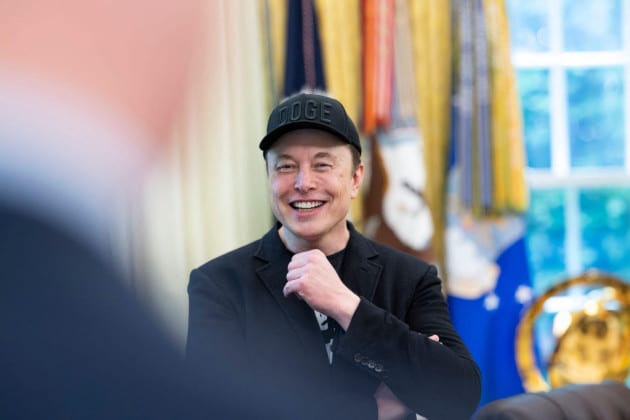 Elon Musk wearing a DOGE baseball cap in the White House Alamy
When EU bans at the outset of the war cut RT off from the European airwaves, Moscow’s messaging apparatus required a more ostensibly independent vehicle to reach Western readers.
Bowes helped to fill this gap through The Islander News, another website he founded in recent years.
His involvement in the project served as a key justification for his recent sanctioning by the EU council.
The legal text of the council’s decision specifically highlighted his work on the outlet, which bills itself as offering “deep geopolitical analysis” and “long-form op-eds” aimed at a “more just world order” on Telegram and Substack.
Like Moscow Mules, The Islander’s primary focus is anti-Western, Kremlin-aligned commentary.
It targets Ukraine and EU institutions, and has also sought to undermine elections in countries on Russia’s periphery.
During contested elections in Georgia and Moldova last year, Bowes framed pro-democracy protests in Tbilisi as an attempted “coup”, while The Islander also amplified unsubstantiated claims of voter suppression and warmongering against Moldova’s pro-EU government.
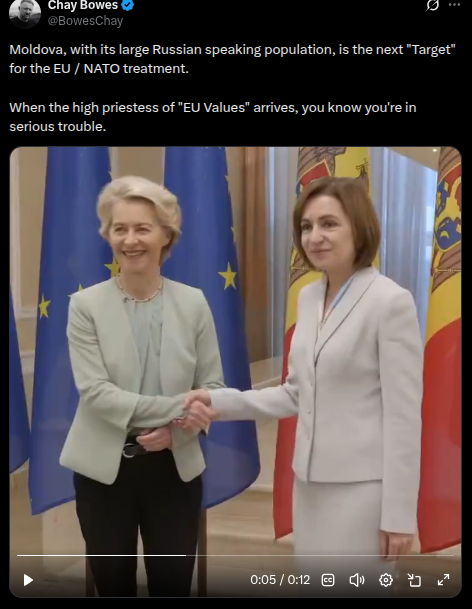 Bowes criticising Moldova in similar terms to his criticism of Ukraine X.com
The outlet has also come under fire for its stance on the invasion of Ukraine, particularly through its laundering and amplification of narratives pushed by Storm-1516, a Russian-affiliated disinformation and influence operation.
In May last year, a report by Vignium – France’s state agency tasked with detecting foreign digital interference – found that the “vast majority” of Storm-1516 narratives were amplified by social media accounts and websites belonging to four named individuals.
One of those individuals was Bowes, with the report including his handle on X and the URL of The Islander featuring alongside his name.
The report said that The Islander was “considered likely to have been paid for or activated by” malicious actors within the Russian information manipulation sector.
“Vignium notes that most of these actors have close links with Russian organisations with a long history of information operations targeting foreign audiences,” the report says.
One of the Storm-1516 narratives identified by Vignium was a false claim from November 2023 that Zelenskyy had bought two luxury yachts worth $75 million (€68 million).
Debunking the story, the Associated Press established that both yachts remained for sale and that the purported sales documents contained outdated branding, and specifically named the Islander as publishing the claim.
Another report by Clemson University in South Carolina also found that Bowes had, through The Islander, shared multiple narratives from Storm-1516 and the Foundation to Battle Injustice, a second Russian disinformation and influence operation founded by the since-deceased Wagner Group founder Yevgeny Prigozhin.
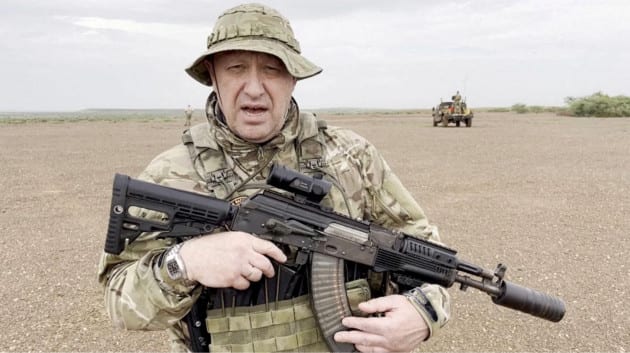 Wagner Group founder Yevgeny Prigozhin Alamy Stock Photo
Russian influence campaigns rely on ostensibly independent sites and trusted Western commentators to give fabricated stories “the appearance of legitimacy” and reach audiences predisposed to believe them, explains Darren Linvill, co-director of Clemson University’s Media Forensics Hub.
Disinformation experts call this process information laundering, a tactic in which state-backed propaganda is routed through seemingly independent third-party outlets to obscure its origins, before appearing to Western audiences as credible news.
Between 2023 and 2024, Linvill says, Bowes’s routine sharing of Storm-1516 claims across The Islander and social media made him, for a time, “Russia’s leading mouthpiece in sharing this set of lies”.
Bowes has said that he is no longer involved in The Islander.
It is reported that he gave control of the project to Nolan in the first half of 2024, a timeline consistent with the fact that The Islander’s newer X account (created in July 2024) lists Nolan as its sole owner.
Even with that shift in ownership, Brussels’ citing of both RT and The Islander in its 16 November decision to sanction Bowes highlights their distinct roles in his wider output.
Although RT operates as a heavily branded, state-stamped broadcast studio, which had been locked out of European airwaves, The Islander worked as a more shadowy operation.
By presenting itself as an independent Anglophone outlet, it managed to dress Kremlin up as impartial commentary to slip past sceptical Western readers on Telegram and Substack.
Bowes continued to post similar claims on his personal channels, so articles and posts published under The Islander’s banner after the transfer of ownership in 2024 cannot be attributed to him.
That didn’t stop him from amplifying Storm-1516 elsewhere, particularly through his account on X.
An analysis by The Journal of his posts on the social media platform found that he promoted at least 10 other narratives identified by Vignium as originating from the group.
Several echoed the same formula as the yacht rumour, alleging extravagant purchases by Volodymyr Zelenskyy and his wife.
In October 2023, Bowes shared a now-deleted post – preserved in an online forum archive – referencing fabricated claims that Olena Zelenska had spent over $1 million (€910,000) at Cartier.
Over the following year and a half, he also helped circulate bogus stories that the Zelenskyys had bought a luxury Bugatti, Sting’s Tuscan estate, France’s Milleis bank, and – according to researchers tracking German election interference – Hitler’s Eagle’s Nest retreat.
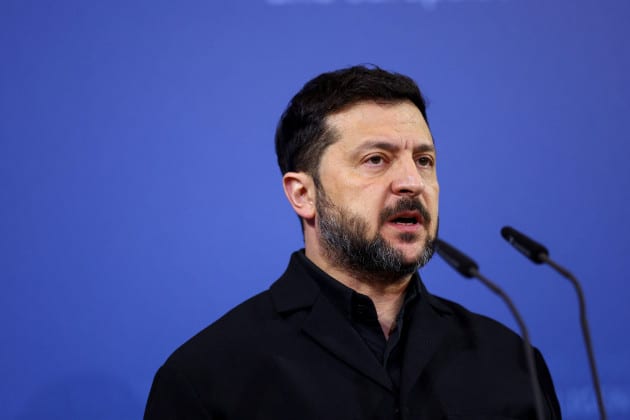 Volodymyr Zelenskyy, a frequent target of Bowes Alamy
Bowes did not always present such claims as established fact.
He openly noted that documents in a post regarding Milleis bank – subsequently debunked by AFP – were uncertain or “unverified”.
“A French video is circulating alleging Zelenskys offshore company was involved in buying a French Bank,” he said on X.
“The unverified report says Milleis Banque was bought via his offshore Co. Maltex for approx €1.2B.”
Other posts targeted high-profile figures and major international events.
In early 2024, he promoted a fabricated story of a Ukrainian plot to assassinate Tucker Carlson, before sharing a smear falsely claiming Russian opposition figure Leonid Volkov was attacked by a former lover.
That July, a post amplifying a fake Hamas threat against the Paris Olympics racked up nearly three million views.
Storm-1516’s Western election narratives also featured prominently on Bowes’ X feed.
Ahead of the US presidential election in October 2024, he shared a fabricated claim accusing Kamala Harris of cocaine addiction.
Months later, during Germany’s federal election, he circulated a staged video falsely purporting to show postal ballots for the far-right AfD being shredded.
That pattern continued between May and July 2025 during an influence push targeting Moldova.
In surviving posts later mapped by researchers, Bowes promote an allegation traced back to the Foundation to Battle Injustice via the fringe outlet Veterans Today.
His focus on European ballots also drew direct pushback inside the EU in May 2025, when Romanian authorities detained Bowes and denied him entry after he flew in from Dublin ahead of a controversial re-run of the country’s presidential election.
He was declared a “threat to the security of the state”, and subsequently boarded a flight to Istanbul.
Nor do his posts simply concern direct Russian interests.
In another study, the Institute for Strategic Dialogue identified Bowes as a frequent commentator on immigration in Ireland in ways that echo claims by Russian state media.
His posts included descriptions of immigration as a “scam” and critiques of the Irish government for giving housing and financial support to Ukrainian refugees, alongside claims that the Ukrainian government was a “corrupted dictatorship”.
“While of course entitled to his personal opinions, it is interesting given his employment as an RT commentator that he selectively framed the Ukrainian government in terms aligning with Kremlin narratives,” the report said.
“With over 270,000 followers on X, his content is available to Irish audiences but is also frequently shared by other actors in pro-Kremlin online spaces.”
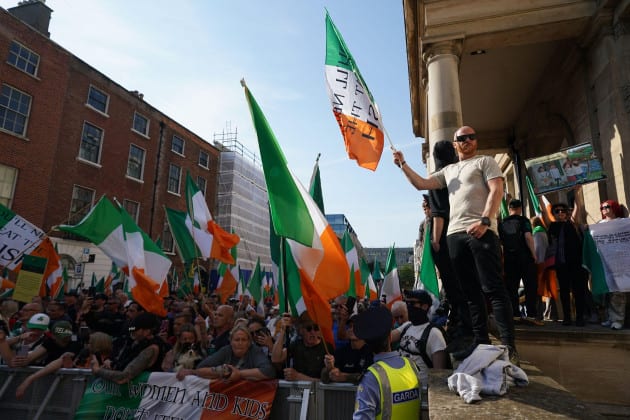 An anti-immigration protest in Dublin in 2024 Alamy
Ciaran O’Connor, a senior analyst at the ISD, points out that Bowes – who recently labelled the EU “an authoritarian network of client states where sovereignty is a memory” – frequently frames migration as an EU-enforced “scam” imposed on Ireland from outside.
According to O’Connor, Bowes also taps into deeply felt domestic grievances in Ireland over housing, immigration and the cost of living in a manner that acts as a “gateway”.
He says this can build trust with local audiences who view Bowes as an independent voice, before gradually introducing them to Kremlin-aligned commentary on Russia and Ukraine they might never have sought out on their own.
Bowes has denied being associated with an influence operation or being paid to post material sympathetic to Russian views.
Clemson University’s Darren Linvill says there is a distinction between active state direction and willing amplification, noting he has seen no evidence that Bowes orchestrated Russian influence campaigns himself.
“I think the evidence points to him being a useful mouthpiece, not a mastermind,” he says.
Bowes has removed posts that contain misinformation, as he did with the fake BBC clip about Ukrainian Nazis once he was contacted by RSF.
Eventually, Brussels decided that Bowes had crossed the line from contrarian commentator to active conduit for foreign interference.
The extensive trail of digital amplification landed him on the European Council’s sanctions list this week.
In its announcement, the council said the decision to target Bowes came amid the backdrop of “increasing Russian hybrid activities aimed at destabilising EU societies”.
The move triggered severe practical consequences for Bowes, leading to his assets being frozen across the EU and a strict ban on EU citizens or entities providing him with funds.
The measures do not prevent him from returning to Ireland, but they effectively quarantine his financial and professional footprint within the EU.
Bowes has aggressively framed the move as an attack on fundamental rights, casting the sanctions as an authoritarian attempt to silence dissenting voices.
“The EU sanctioned me for being a ‘disinformation hub’,” he wrote on X afterwards.
“No evidence, no hearing, nothing. Now I can’t move around the EU, can’t bank, and can’t receive money. All because I challenged the Western narrative on Ukraine.”
Others rowed in to defend him, including former Independents4Change MEP Clare Daly, who described the sanctions as “extrajudicial punishment for disfavoured speech”, and the aforementioned TD Richard Boyd-Barrett, who claimed they were issued to a “journalist for not toeing [the] western line”.
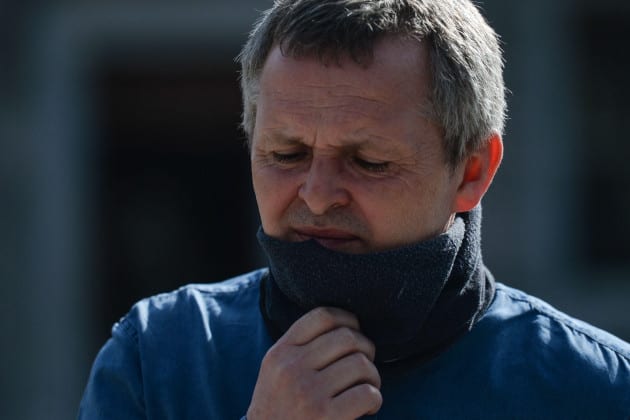 People Before Profit TD Richard Boyd-Barrett Alamy
Their defence taps into a vital democratic question about an individual’s right to challenge prevailing orthodoxy.
But the documented trail of interference at such a heightened time would also lead to questions if Brussels didn’t act.
The council’s legal text surgically cited Bowes’ active involvement in “information manipulation” and his role as a key amplifier for operations like Storm-1516.
The threshold for sanctions was deemed to have been crossed not when Bowes voiced pro-Kremlin views, but when his commentary became, in the opinion of the European Council, a documented conduit for malicious foreign interference.
Bowes has framed the move as censorship, arguing on X that he was sanctioned without a hearing or evidence merely for offering “dissenting opinions”.
Gavin Barrett, professor of EU constitutional and economic law at University College Dublin’s Sutherland School of Law, notes that while EU measures must be legally reasoned, Bowes can challenge his listing before the EU courts in Luxembourg under Article 263 of the Treaty on the Functioning of the European Union.
Any such challenge would likely invoke Article 11 of the EU Charter of Fundamental Rights, which protects freedom of expression and media pluralism.
Yet Barrett notes that judges would weigh that protection against “times of massive media manipulation”, scrutinising his role at banned state broadcaster RT alongside posts sharing a fake BBC clip and a staged German ballot-shredding video.
“A court might well take the view that this kind of activity is far removed from the kind of legitimate journalistic activity intended to be protected by the Charter,” he says.




have your say