Sign in. It’s quick, free and it’s up to you.
An account is an optional way to support the work we do. Find out more.
Sign in. It’s quick, free and it’s up to you.
An account is an optional way to support the work we do. Find out more.
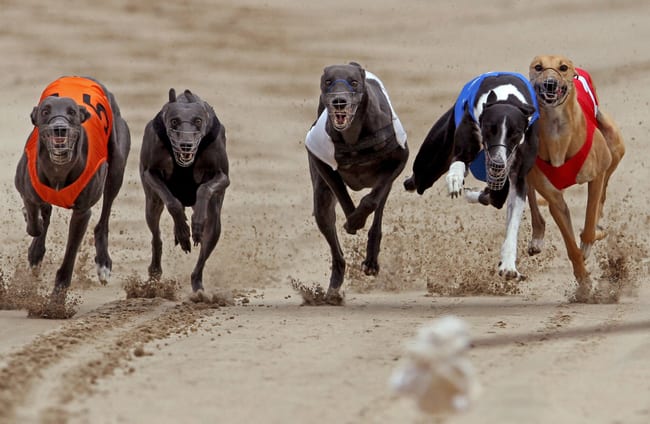
A FEW MONTHS ago we examined the curious case of greyhound races at Youghal stadium in Cork.
These events are almost always empty. In fact, the venue recorded just two paying customers for the entirety of 2024.
Yet week after week, the races went on. Why?
Because the stadium has a “commercially attractive” deal with Sports Information Services.
This is a British firm which specialises in broadcasting horse and greyhound races directly to bookmakers across Ireland and the UK.
This arrangement means that the greyhound races at Youghal stadium are run entirely to supply the gambling industry with a product for its bettors.
This raises multiple questions, many around ethics and animal welfare.
But from a pragmatic point of view, the Irish public could also ask – why should my taxes pay for this?
Youghal stadium received taxpayer funding of €763,000 between 2020 and 2022. Despite this, it almost closed its doors in 2023, only being kept open via a bailout / more state money.
Why should the state subsidise this?
The question has reared its head in recent weeks after the Parliamentary Budget Office (PBO) published a report titled ‘Ireland’s Costly Love Affair with Greyhounds’.
The Oireachtas spending watchdog seriously questioned the government’s decision to provide the greyhound sector with €20 million in funding per year.
It pointed out a variety of ethical concerns over the welfare of greyhounds, such as how thousands reportedly die every year.
It also raised concerns over the industry’s business case, as attendance at greyhound racing has plummeted over the last two decades (down by about 75% since 2005) and there are major questions over how many jobs it supports.
Since its publication, there has been a growing push for an independent economic review, to see if the state is justified in providing €20 million a year to the sector.
The Government has now said it will consider an objective cost-benefit analysis of the industry.
However, there are some major problems with its proposal. The first is that agriculture minister Martin Heydon said that Greyhound Racing Ireland (GRI) would organise the review.
How likely is it that a review commissioned by GRI will recommend cutting funding to GRI? Turkeys voting for Christmas comes to mind.
But leaving that aside for a moment, a straightforward cost-benefit analysis risks missing a more fundamental question.
That is – should Irish taxpayer funds support gambling?
This is an issue which the PBO does touch on in its report. The study concluded by stating: “It remains unclear whether there is a sufficiently strong policy rationale for continued State funding of an industry that derives a significant proportion of its income from gambling-related activity, particularly given the wider social and economic harms associated with problem gambling.”
However, this report does not really dive into the issue, understandably focusing more on the topics of animal welfare and dwindling racetrack attendances.
But it should be included in any proper review of how the Irish state provides funding to greyhound racing.
Let’s go back for a moment to Sports Information Services and look at some of its customers.
The business supplies greyhound racing broadcasts to bet365, Paddy Power and Betfred.
In 2025, bet365 recorded pre-tax profits of £348.7 million (€416.43 million).
Paddy Power is part of the UK & Ireland (UKI) division at gambling group Flutter. The company stopped publishing standalone profit figures for the unit in 2024, but at the time it reported that UKI was the company’s highest-margin division, with a margin of 31%. This translated into earnings of more than $1 billion (€909.92 million) from revenues of $3.6 billion (€3.28 billion).
Betfred recently saw its sales hit £1.5 billion (€1.79 billion), with the company’s founders sharing a £25 million (€29.86 million) payout.
These are hardly struggling companies. So again we return to the question – why should Irish taxpayers be spending money to provide a product to these businesses?
Because there is a direct line from one to the other. The Irish government provides funding for greyhound racing.
Many parts of the industry, such as Youghal stadium, essentially exist only to supply broadcasters greyhound races that gambling customers can bet on.
The gambling companies using these broadcasters then get a useful product, which contributes to their enormous profits.
This funding also comes at a time when the Irish government is trying to tackle the cost associated with problem gambling.
People affected cost the state in a variety of ways, such as via higher healthcare costs (treatment for gambling or mental health disorders) or lost revenue (poorer productivity and possible unemployment).
The UK has hard numbers on this, with a 2023 study finding that problem gambling cost the state ‘at least’ £1.4 billion (€1.67 billion) in a year.
Ireland has not carried out a similar study, although researchers at the ESRI (Economic and Social Research Institute) recommended in 2023 that the government should do so.
But it is certain that problem gambling does cost the Irish state money every year, with problem gamblers typically spending more than €1,000 per month on betting.
It is a significant enough issue that the government is introducing a new levy on gambling companies in April.
The charge, set at 1% of a company’s turnover, is explicitly to set up a new fund to tackle gambling harm.
The notification from the government states: “The purpose of the Social Impact Fund is to finance research and related initiatives aimed at addressing compulsive and excessive gambling.”
The Irish government knows problem gambling is bad. It knows that it directly costs the state money. It makes its funding of the greyhound racing sector all the more puzzling.
To be clear – there are plenty of similar issues around the horse racing sector. But this is one we will look at in more detail another day – the focus for now is on greyhounds.
And of course, the funding of the sector comes on top of the well-documented animal welfare issues. Ireland is one of just three countries in the world in which commercial greyhound racing remains legal. While it is technically in the US too, greyhound racing is illegal in 44 out of 50 states.
This all raises the uncomfortable question – is the Irish state propping up an industry which causes harm to animals, largely for the benefit of the gambling industry?
It is a fundamental question which must be addressed.
Any cost-benefit review looking at Ireland’s greyhound racing sector which does not, is doomed to failure.


have your say