Sign in. It’s quick, free and it’s up to you.
An account is an optional way to support the work we do. Find out more.
Sign in. It’s quick, free and it’s up to you.
An account is an optional way to support the work we do. Find out more.

I’VE SPENT OVER a decade writing about restaurants, observing them and examining their inner workings. You may think the job is about eating, but the reality is more of an exercise in observation: noticing the little details beyond what’s on the plate which others might not clock.
I’m like a human tuning fork, dialling in on a restaurant’s service, and over the last year or so I’ve started to notice something: is there widespread understaffing, or just me?
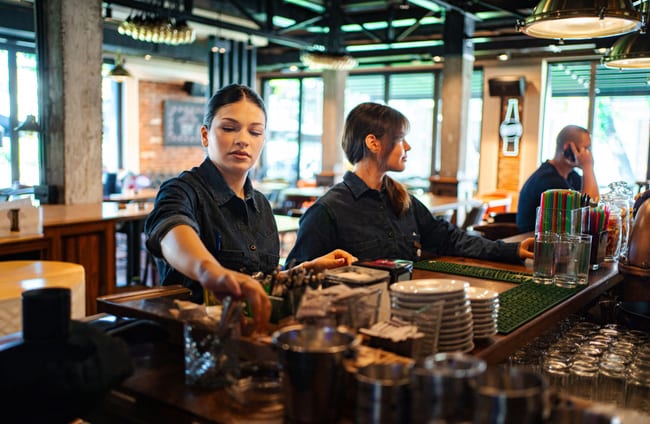
You’ve probably experienced it yourself. A tediously long wait to order. Starters delivered before your first drink. Finished plates taking an age to be cleared. Chasing staff for the card machine 15 minutes after the bill lands. But, then, upon closer inspection: the phone ringing without answer, the same server walking food one minute then making calypso coffees the next, service that stutters when it should flow fluently. The result? A sluggish experience from a team visibly stretched, a brigade lean to the point of gaunt.
When did we normalise a restaurant floor running on two people, a hope and a prayer?
The thing is: when service is good it’s effortless, gliding elegantly like a jet on autopilot on the clearest summer’s day. A pleasure to be privy to. When it’s bad it can resemble a multi-vehicle collision on a motorway, a chaotic chain reaction that nobody gets out of unscathed with a room full of rubberneckers to witness it.
My hot take is that almost everywhere I dine of late seems to be understaffed, needing one, if not two, more pairs of hands on the rota every single service. But team members darting between kitchen and floor spinning plates are not really the problem here. In fact, they are the ones usually plugging the holes and saving the whole thing from sinking.
If this phenomenon is bubbling so widely across the industry, one has to wonder whether it’s actually a shrewd operational decision. Shave a little off the labour costs to make the team as lean as it can be, naively hoping to deliver the same level of service. That’s the bit that really flares my nostrils. If managers are intentionally rolling their teams out to filo thinness and then the team struggles to handle each busy service, what exactly has been made more efficient?
There’s a difference between a restaurant being unexpectedly busy or caught on the hop and a restaurant that never had enough reinforcements in the first place. Just as there’s a difference between general bad service and service that’s doing its best but simply unable to cope.
Good staff are hard to come by and even harder to keep, many restaurateurs will agree. But great, capable staff are worth their weight in gold with the power to elevate and enhance everything from the simplest bap and brew to the finest culinary creations. They are the literal and figurative vehicle between chef and customer.
However, when the actors are visibly struggling to keep the show going, it’s difficult for anyone in the room to enjoy the performance.
I’m not a restaurateur by trade, so I don’t know the intimate ins and outs of running a restaurant, but I am an observant, professional diner, and I’ve probably eaten in their restaurants more times than most restaurateurs have. I can imagine the balance sheet teeters on a knife edge by the week. Even this year alone a triple whammy of labour cost increases landed: minimum wage, employer PRSI and pension auto-enrolment measures. However, I don’t want a sub-par level of service when expected to pay full price and later encouraged to add on a service charge.
Look, even the most healthily-staffed restaurant doesn’t automatically guarantee superior and seamless hospitality, but it does begin from a stronger base. But the calculation floating around the industry seems to be that fewer people on the rota equals lower costs so therefore a healthier bottom line. The crux is: that supposed saving comes at the expense of the customer experience, and I don’t believe that should be the customer’s cross to bear.
Last week Bord Bia reported that Ireland’s foodservice market “continues to perform strongly, reaching a record value of €10.8 billion this year”. In its annual Market Insights Report it warned that the Irish foodservice sector has evolved into “a very different environment” from what it was even a few years ago. Rising labour costs and skills shortages remain the “defining challenge facing foodservice businesses” amid what Bord Bia describes as a “structural reset, rather than a temporary squeeze”.
So, what’s the solution? Maybe it’s reconsidering restaurateurs’ spaces and adjusting the scale of their ambitions. Do restaurants themselves, rather than the waiting staff that serve them, just have to make themselves smaller to make the sums work? Lessen the footprint, reduce the tables, rein in the opening hours and streamline the menu?
Perhaps the neighbourhood bistro is the solution? Micro restaurants set in residential pockets which can manage with one or two on either side of the pass and only open for dinner a couple of evenings a week? Does that make the experience better, all round, for the staff and customers? Would it balance the budget sheet more convincingly?
In the desire to stay super lean, restaurants are risking the most precious thing they sell: hospitality.
Patrick Hanlon is an Irish food, travel and culture journalist, and is one half of the award-winning duo GastroGays. He is the author of a new food column, The Feeder’s Digest at TheJournal.ie. More on Instagram.







have your say